Category: Cryptography

  • Cryptography Puzzle Creation

    Aim

    This task aims to assess your understanding of cryptography concepts, and encryption techniques, creativity and problem-solving skills, and collaboration skills with your partner.

    Your task is to create a cryptography puzzle that consists of at least 3 layers of security. Your puzzle should use a range of cryptography techniques including one of the cipher methods we learned in class.

    How it will be Assessed

    Your puzzle will be graded according to the following criteria:

    • Collaboration & contribution skills.
    • Creativity and complexity.
    • Understanding & implementation of Encryption techniques.
    • Clarity of instructions & hints
    • Presentation & peer engagement to the testing of others puzzles.

    The rubric for this task can be found here:

    Instructions

    Follow the steps below carefully to complete the task.

    Step 1: Research, inspiration and ideas.

    Conduct research based on encryption methods we have covered in class, as well as additional ideas you may be able to use to help create your puzzle.

    Record a list of your ideas on a Word Document.

    Step 2: Make your puzzle.

    Begin the process of creating your puzzle. Establish what will happen in each layer of security and encryption.

    (Feel free to collect resources and materials or make your own in this stage.)

    Begin making your clues, hints or steps required to complete your puzzle. Ensure these are presented in a way for someone to follow.

    Step 3: Testing your puzzle.

    Test your own puzzle to ensure it works. If there are any changes or amendments to be completed, ensure they are corrected before final submission and presentation.

    Step 4: Presenting your puzzle.

    Discuss the best way to present your puzzle to the group with me and gather any resources needed to do so.

    You will have half a lesson to present your puzzle to the group as well as take part in the completion of other groups puzzles.

    Example Puzzle Ideas:

    Use the ideas below to help your get started:

    Substitution Cipher Puzzle:

    Encrypt a short message using a simple substitution cipher (e.g., A=1, B=2) and provide a key for reference.

    Include hints like “The alphabet has been shifted by 3 positions.”

    Transposition Cipher Puzzle:

    Rearrange the letters of a sentence using a transposition cipher and provide a clue on the rearrangement pattern.

    Offer a hint like “Read every third letter in reverse.”

    Caesar Cipher Puzzle:

    Encrypt a famous quote using a Caesar cipher with a specific shift value.

    Provide a hint that indicates the shift value, but not the plaintext.

    Vigenère Cipher Puzzle:

    Develop a Vigenère cipher puzzle and provide a keyword.

    Challenge your peers to decipher the message with the given keyword.

    Hints and Tips:

    • Think outside the box!
    • Incorporate basic puzzles like dot-to-dots, crossword puzzles or find-a-words into your puzzle to add layers of complexity.
    • Revisit past grok modules, How do they create puzzles?
  • One Time Pad

    What is a One Time Pad?

    A one time pad, also known as a “Vernam cipher” or “perfect cipher,” is an encryption technique that provides absolute security when used correctly. It works by using a random key that is as long as the message itself. This key is used only once, hence the name “one-time pad.”

    Think to yourself…
    What benefits would having the key as long as the message have?
    What limitations could this pose?

    Key characteristics?

    Perfect Security: When used with a truly random and secret key, a one-time pad provides perfect security. This means that even with unlimited computational power, an attacker cannot determine the original message. This is because the key is as long as the message, making it statistically impossible to crack.

    Key Length: The key must be as long as the message, which can be a limitation for practical use. Sharing long, random keys securely can be challenging.

    Key Reusability: The key should never be reused for another message. Reusing a one-time pad key weakens the security because it allows patterns to emerge that attackers might exploit.

    Key Security: Protecting the secrecy and integrity of the key is crucial. If the key is compromised, all security is lost.

    Limited Practical Use: One-time pads are rarely used in modern communication due to their limitations, especially in securely distributing and managing long, random keys. Instead, modern encryption methods like public-key cryptography and symmetric-key algorithms are more practical for most purposes.

    How does it work?

    Key Generation: To encrypt a message using a one-time pad, you need a random key that is as long as the message. This key can be generated using truly random processes, such as a hardware random number generator, to ensure that it’s unpredictable and unique for each use.

    Key Distribution: The key must be securely shared between the sender and the receiver. This is a significant challenge because if the key is compromised or intercepted, the security of the system is lost. In practice, this is one of the main limitations of one-time pads.

    Encryption: To encrypt a message, the sender combines each character of the plaintext (the message) with the corresponding character in the key using modular addition. This process creates the ciphertext. The key is never reused for another message.

    Decryption: To decrypt the message, the receiver uses the same one-time pad key and subtracts it from the ciphertext using modular subtraction to recover the original plaintext.

    Have a go at a Vernam Cipher here.

    Is it effective?

    A one-time pad is a theoretically perfect encryption method that relies on using a random and secret key that is as long as the message. While it provides unbreakable security, it has practical limitations that make it less suitable for most everyday encryption needs.

    Parting Question

    If I wanted to set up a one-time-pad for use to swap secret messages with someone, how would I do this?

  • Cipher Refresh

    Ceasar Cipher Refresh

    Watch the video below to recap how a simple Ceasar Cipher works. Practice manually ciphering messages with a partner to reinforce these ideas.

    Vignére Cipher Refresh

    Watch the video below to recap how to Encrypt and Decrypt using a Vignére Cipher. Practice manually ciphering messages with a partner to reinforce these ideas.

    Encryption and Decryption Practice

    Step1:
    Fill out the sheet above. Encrypt your answers with a Caesar cipher. Swap with a partner and have them decrypt your answers.

    Take your encrypted answers and fill out the cipher text

    (For an Extra challenge, don’t provide the key to see if they can crack each other messages first.) 

    Step2:
    Fill the same sheet out again, but this time encrypt your answers with a Vignére cipher.

    State the key and swap with a partner to decrypt your answers.

  • What is a Vignere Cipher?

    The Vigenère cipher is a method of encrypting alphabetic text by using a simple form of polyalphabetic substitution. Essentially it is a series of interwoven caesar ciphers, however it uses a word as a key instead of a number or series of numbers.

    Think to yourself…
    What benefits could this have?
    What would it reduce? 

    Have a go at a Polyalphabetic Cipher here.

    Is it effective?

    Whilst a Vigenére Cipher is more difficult to break with brute force, it is more effective than a simple Ceasar Cipher. However, it can be broken if the length of the keyword is guessed.

    How does it work?

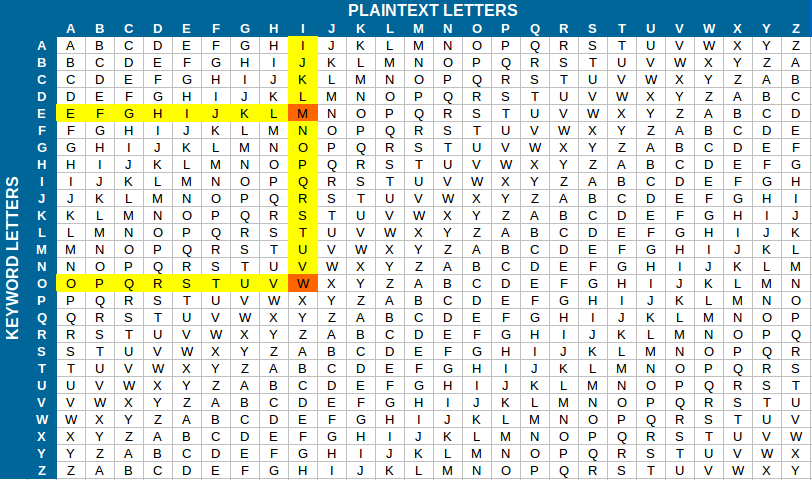
    The Vignére Cipher uses a Vignére square to encrypt and decrypt text.

    Let’s give it a go…

    Joe’s favourite type of pizza is?
    CSTWZG

    Key: CYBER

    Race for the Code

    Aims:

    Be the first team to find the secret code and tell it to the teacher to win.

    Rules:

    Respect other classrooms by not disrupting others classes in the area.

    Strictly paper and pen.

    Don’t fight, have fun!

    Game Clues

    Clue 1: YLZABHSXXRYICORDW

    Clue 2: RZXMBFHS

    Clue 3: WWYPYLDZHHEVRGXCR

  • The Amazing Cipher Race

    Clue 1: Home Base

    vwduw brxu dgyhqwxuh dw wkh frruglqdwhv 40°42’42.4″q, 74°00’25.8″z. brx’oo ilqg d idprxv odgb khuh zkr nqrzv doo derxw iuhhgrp.

    Clue 2: Natural Wonder

    mjfi bjxy yt knsi f lwfsi ufwp. dtz bts’y sjji f mjqnhtuyjw yt jcuqtwj ny. ozxy ettr ns yt xjj ymj gjfzynkzq htqtzwx.

    Clue 3: The Ancients

    xvezip egvsww xli kpsfi xs e hiwivx alivi csy’pp jmrh er sph kmde. xliwi wxvygxyviw lezi fiir wxerhmrk jsv xlsywerhw sj cievw.

    Clue 4: Underwater Expedition

    kpcl kllw puav aol vjlhu av kpzjvcly h mhtvbz yllm. fvb tpnoa zwva ultv huk opz myplukz olyl.

    Clue 5: City of Lights

    kvef csyv fivix erh zmwmx e gmxc xlex riziv wpiitw. psso jsv e xepp tsmrxc fymphmrk wyvvsyrhih fc fvmklx pmklxw. mx’w e viep wlsawxsttiv!

    Clue 6: Mystery Location

    puaxtke zu g rgtj ul gtioktz seyzkxoky gtj sgyyobk yzutky zngz yzgtj zgrr ot znk ktmroyn iuatzxeyojk. znkyk seyzkxouay ioxirky nurj ykixkzy lxus znk joyzgtz vgyz.

    Clue 7: World Heritage

    yg’xg jkffgp uqogvjkpi urgekcn jkij qp c oqwpvckp. vjku rnceg ku mpqyp hqt kvu nwuj tckphqtguvu cpf gzqvke cpkocnu. c hcnn htqo vjku jgkijv yknn egtvckpna mknn aqw cpf kh pqv, vjg nncocu cpf cnrcecu okijv.

    Clue 8: Final Destination

    jzfc qtylw opdetyletzy td l eczatnlw alclotdp qlxzfd qzc ted zgpchlepc mfyrlwzhd, nzclw cppqd, lyo nwplc mwfp wlrzzyd. rpe cploj ez cpwli zy dlyoj mplnspd lyo dhtx ty hlcx, ncjdelw-nwplc hlepcd.